 How-to
How to Personalize a Wedding DJ Playlist That Fits Your Guests
Last Updated: October 31, 2026
Quick Summary
A personalized wedding DJ playlist is built around the couple and their guests, not a generic list of party hits. Start with a short questionnaire, pick a focused must-play list, then map songs to each reception moment and energy level.
- Share a short questionnaire with your DJ early to reveal genres, decades, and off-limits songs.
- Mix eras on purpose so no single age group sits out for long.
- Open the dance floor peak with mid-tempo crowd-pleasers, not your highest-energy track.
- Write a one-page timeline with moments, time windows, energy levels, and anchor songs.
Table of Contents
- Why a Personalized Wedding DJ Playlist Beats a Generic One
- Start With a Wedding Playlist Questionnaire
- Build Your Wedding DJ Must-Play List
- Set a Wedding DJ Do-Not-Play List Without Overthinking It
- Map Your Wedding Reception Playlist Ideas to the Timeline
- Balance Your Taste With Guest Requests and Real-Time Decisions
- Book Your Personalized Playlist Planning Session With Agondray
- Frequently Asked Questions
Why a Personalized Wedding DJ Playlist Beats a Generic One
Your wedding DJ playlist is one of the few parts of the day your guests will remember by sound. A generic list of party hits can fill a room, but it rarely fills it with your people.
Think about a typical wedding reception. Your guests range from grandparents to college friends. Some want slow songs, some want to shout every word of a 90s anthem. A stock playlist treats them all the same.
A common mistake is picking songs you love and assuming everyone else will too. Your taste matters, but it's only one input.
Watch out: A playlist that's too narrow kills momentum. If every song sounds like your own library, the floor empties after three tracks.
Start With a Wedding Playlist Questionnaire
Before you pick a single song, get the basics on paper. A short questionnaire gives your DJ the information they need and saves you hours of guessing.
Ask yourselves these questions:
- What genres do we both enjoy?
- Which decades matter most to our families?
- Are there songs that are off-limits for religious, cultural, or personal reasons?
- What's the age range of our guests?
- Do we want a formal feel, a relaxed party, or a mix?
Share your answers with your DJ early. A good DJ will use them to shape the flow of the night, not just fill a list. Couples often find the questionnaire reveals gaps they hadn't noticed, like forgetting a song that everyone from one side of the family loves.
Build Your Wedding DJ Must-Play List
Your must-play list is the set of songs you absolutely want to hear. Once your list is ready, read how to pick a wedding DJ to find one who can work with it. Keep it focused.
Group your picks into categories so they're easy to place in the timeline, and aim for a rough count in each:
- First dance (1-2 songs): One song that feels like you as a couple, plus a backup in case the original runs long or the version you love isn't danceable. Classics like Etta James's "At Last," Ray LaMontagne's "You Are the Best Thing," or a stripped-back acoustic cover are slow enough to sway to without dragging.
- Parent dances (2 songs): One for each side, or a combined dance if that fits your families. "My Girl" by The Temptations, "What a Wonderful World" by Louis Armstrong, and "Isn't She Lovely" by Stevie Wonder are perennial picks because they're warm without being maudlin. If a parent has a favorite artist, that's a stronger choice than any list.
- Crowd-pleasers (5-8 songs): The songs every age group knows. Think "September" by Earth, Wind & Fire, "Dancing Queen" by ABBA, "Sweet Caroline" by Neil Diamond, "I Wanna Dance With Somebody" by Whitney Houston, and "Shout" by The Isley Brothers. These are your floor-fillers, the songs that pull people out of their chairs without a request.
- Current hits (3-5 songs): A few recent songs so younger guests feel included. Pick from what's actually charting in the months before your wedding rather than guessing a year ahead; a song that's everywhere at your engagement party may be tired by the reception.
- Personal favorites (3-5 songs): Songs with a story only you two understand, the track from your first road trip, the song playing when you got engaged, the guilty pleasure you both sing badly in the car. Tell your DJ the story behind each one so they can introduce it well.
Mix eras on purpose. A 1970s disco track followed by a 2010s pop song keeps the energy moving across generations.
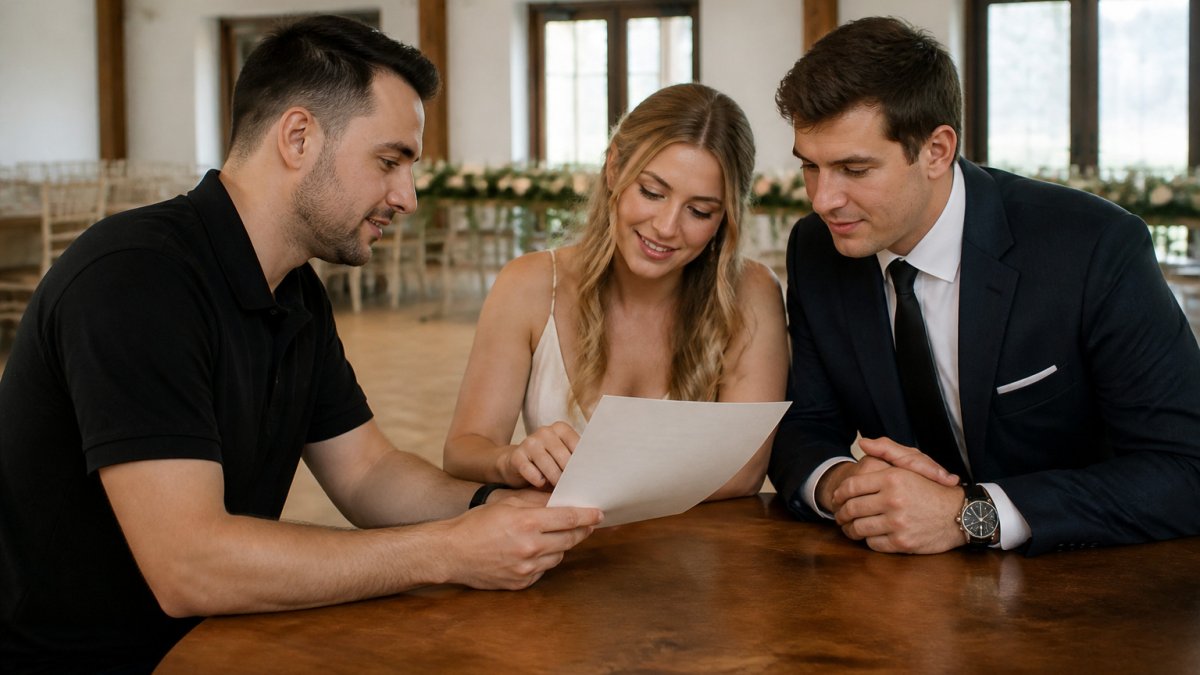
Once your list is set, send it to your DJ with a note on where each song should go, first dance, parent dance, mid-dance-block, or closer. A list without placement notes forces the DJ to guess, and guesses are where good playlists go wrong.
Set a Wedding DJ Do-Not-Play List Without Overthinking It
A do-not-play list protects the mood you're going for. It doesn't need to be long, and it doesn't need to be a judgment on anyone's taste.
Focus on a few clear categories:
- Songs with explicit lyrics, unless you want them
- Songs tied to a painful memory or an ex
- Tracks that don't fit the vibe of your event
- Anything with strong religious or cultural sensitivities in your family
Keep the list short and specific. "No songs about breakups" is clearer than a long list of titles. Mention clean edits of explicit songs too if you want them.
Map Your Wedding Reception Playlist Ideas to the Timeline
A great playlist depends on timing as much as song choice. A slow ballad at the wrong moment can drain the room. The right song at the right time builds energy. Most song lists stop at "here are 100 hits", the real personalization happens when you map music to each reception moment and decide how the energy should rise and fall.
Pre-Ceremony and Ceremony (20-30 minutes before, plus the service)
Guests arrive and mill around, so keep it instrumental or low-vocal: acoustic covers, soft piano, string quartets, or light jazz. Save anything with a strong hook for later, a song guests love but can't dance to during seating just creates restless energy. For the ceremony itself, plan three cues: the processional, the couple's entrance, and the recessional. Pick the recessional for energy, not sentiment, it's the first signal that the party is starting.
Cocktail Hour (typically 60 minutes)
Relaxed, familiar tunes that let guests chat and reconnect. Think jazz, acoustic covers, soft soul, or light Motown. Volume matters more than genre here: conversational volume, not dance volume. This is also a good slot for songs that matter to you but aren't dance-floor material, the indie track you bonded over, a favorite artist's deeper cuts. Your DJ can work them in at a volume that keeps the room comfortable.
Dinner (45-75 minutes)
Background music at a conversational volume. Skip anything too loud or distracting, and avoid songs with long spoken intros or big dynamic swings that fight table conversation. A common pattern is to shift from cocktail-hour jazz into soft classic soul or acoustic pop as dinner progresses, so the room subtly wakes up without anyone noticing the transition.
Formal Dances (15-20 minutes)
First dance, parent dances, and any cultural or family dances. Sequence matters: open with the first dance while all eyes are on you, then move into parent dances, then invite guests to join for the last minute of the final parent dance. That invitation is the bridge from performance to party, without it, the floor stays empty when open dancing begins.
Open Dancing (90-150 minutes)
This is where the energy peaks, and where a personalized plan beats a generic one. Plan the energy curve in three phases:
- Warm-up (first 20-30 minutes): Mid-tempo crowd-pleasers that reward the guests already on the floor, Motown, disco, singalong pop. Don't open with your highest-energy song; you'll have nowhere to go.
- Peak (middle 45-60 minutes): Your highest-energy songs, party anthems, and the must-plays you ranked at the top. This is when you want the songs that make every generation move, "Shout," "September," "Yeah!" by Usher, "Mr. Brightside" by The Killers.
- Ease-off and closer (final 20-30 minutes): Pull back slightly so guests can catch their breath, then finish with a song you want to remember. Many couples choose a sentimental closer, the song from their first date, or a slow one that brings everyone together, rather than ending on the highest-energy track.
Late Night (optional)
If your reception runs past the main dance block, this is the slot for guilty pleasures, deeper cuts, and the songs only your closest friends know. It's also where guest requests fit best, because the pressure to please everyone has eased.
The article breaks the reception into moments, each with its own time window and energy level, so the music can rise and fall with the night.
| Moment | Time | Energy |
|---|---|---|
| Pre-ceremony and ceremony | 20-30 min before, plus service | Low |
| Cocktail hour | About 60 minutes | Low to medium |
| Dinner | 45-75 minutes | Low |
| Formal dances | 15-20 minutes | Medium |
| Open dancing | 90-150 minutes | High |
| Late night | Optional, after main dance block | Varies |
Balance Your Taste With Guest Requests and Real-Time Decisions
Your playlist is a plan, not a contract. Guests will make requests, and a skilled DJ will read the room and adjust.
Decide ahead of time how you want requests handled. Some couples accept any request that fits the vibe. Others want a short approved list. Either way, tell your DJ your preference.
Trust your DJ's judgment in the moment. If a song isn't working, a good DJ will adjust without waiting for instructions. Your job is to set the foundation. Their job is to read the floor and keep it alive.
Watch out: Don't promise a song to a guest you can't deliver on. A quick "we'll see what we can do" is better than a disappointed request later.
Book Your Personalized Playlist Planning Session With Agondray
Building a personalized wedding DJ playlist takes time, and you don't have to do it alone. Agondray Entertainment LLC works with Central Florida couples to turn their questionnaire, must-play list, and timeline into a plan that fits their guests. For current pricing and availability, visit our website and reach out for a quote. Let's get started.
Frequently Asked Questions
How do you make a wedding playlist feel personal?
Start with the songs that mean something to you as a couple, such as the music you played on early dates or the artists you both love. Then add songs that reflect your families and guests, including music from each generation in your lives. Share a short written brief with your DJ explaining the mood you want at each stage of the reception. A personal playlist is less about picking unusual songs and more about making sure the music connects to your relationship and your guest list.
How many songs should you give your wedding DJ?
Most couples give their DJ a must-play list of roughly 20 to 50 songs, then let the DJ fill the rest of the night with music matched to the room. A longer list gives the DJ more options but can make it harder to keep the energy moving. Focus on the songs that matter most to you for the first dance, parent dances, and key moments, and leave the middle of the night flexible. Your DJ can tell you what works best for the length of your reception.
Should you give your wedding DJ a do-not-play list?
Yes. A do-not-play list keeps songs that would be awkward, offensive, or unwelcome out of the mix. Common entries include songs with explicit lyrics if you want a clean event, tracks connected to a painful memory, or songs that conflict with your religious or cultural traditions. Keep the list focused on a handful of clear decisions instead of a long list of personal dislikes. Give it to your DJ early so they can plan transitions around it.
Can a wedding DJ take song requests from guests?
Most wedding DJs will take song requests during the reception, but they usually check each request against your must-play and do-not-play lists and the flow of the night. You can decide in advance whether guest requests are welcome during open dancing, or whether they should go to a request box or a specific time block. Let your DJ know how you want requests handled so guests get a response without disrupting the timeline.